Institutional Impact Management · Proven, not promised

Every vendor sells AI.
We prove what works.

The Institutional Impact Platform connects Banner, PeopleSoft, Workday, Slate, Canvas, Salesforce, and 100+ other systems into one model of your institution, trains AI on it, and measures the impact of every decision. Show your board what moved the numbers. Stop paying for what didn't.

Free, no login: national post-graduation outcomes — employment timing, the earnings premium four years out, and career paths, pooled across 11 institutions and published as privacy-protected aggregates. Explore the National Career Survey →

Institutional Impact Management

One continuous cycle of intelligence, action, and learning, across the whole student journey. The Institutional Impact Platform is where your teams do that work.

  1. Recruit
  2. Enroll
  3. Success
  4. Progress
  5. Graduate
  6. Employ
The Institutional Impact Gap

The work is happening. The outcomes are not moving.

Institutions invest in people, programs, technology, and data. The harder problem is turning all of it into measurable impact: knowing what matters, acting while there is still time, coordinating the people involved, and then learning whether the action worked. That gap sits between the institution and its mission, and it usually breaks in four places.

Fragmented insight

Teams cannot build one trusted view of what is happening, so each office answers the same question differently.

Delayed action

Risk and opportunity are recognized after the best moment to act has passed.

Disconnected teams

Different groups work from different information, priorities, and processes.

Manual effort

Manual work and growing responsibilities limit how consistently the institution can respond.

Civitas Learning AI

See what your teams can do when AI starts with your institution.

Predict what’s coming next and know which students need support now. Scale the strategies that work with AI agents that take on repeatable work, and give teams time back with built-in tools that make everyday tasks easier.

How Civitas Learning AI works →

Run the numbers

What is one point of retention worth to you?

Start with your institution's own IPEDS figures, then move the slider.

$—
additional net revenue per year, from students retained
Students retained who would have left

Models the lift as a share of undergraduate headcount retained, for one more year of net price. Multi-year and state funding effects are excluded, so treat it as a floor.

Trusted by colleges and universities of all sizes

University of CincinnatiThe University of Texas at San AntonioTexas A&M University–San AntonioWest Hills Community College DistrictVentura County Community College DistrictThe University of Texas at TylerLorain County Community CollegeWayne State UniversityNorthwest Missouri State UniversityAustin Community CollegeSlippery Rock UniversityWestern Kentucky UniversityJackson CollegeSt. Olaf CollegeSUNY Broome Community College
220+
initiatives measured against a comparison group, multi-year
6
outcomes modelled per institution, one model each, retrained every term
~5%
first-year fall-to-fall retention increase, Fall 2022 cohort, UNC Asheville
One institution · one dataset

How do you get one view of a student across every system you run?

Your systems already hold the answer. They just don't talk to each other. An operating system runs the work; Civitas proves it paid off. Civitas reads from 100+ systems — including AI agent and CRM tools you may already own — builds one model of the institution, and writes actions and results back. Keep your advising CRM, or use ours: case management, degree planning, registration, scheduling, and a native student mobile app. The measurement is the same either way.

Systems you keep · 100+ integrations
SISBanner · PeopleSoft · Colleague · Workday Student
LMSCanvas · Blackboard · D2L · Moodle
CRMSlate · Salesforce · Element451 · CollegeVine · TargetX
HR & financeWorkday · Oracle · Ellucian
Everything elseWarehouse, engagement tools, card swipes, surveys, and more
Institutional Impact Platform
UnifyOne student, one course, one program record across every system.
PredictSix outcomes, a model each, trained on your history and retrained every term.
ActAI agents work inside the tools your staff already open.
MeasureEvery action scored against a matched comparison group.
Strategic partnership

People come with the platform. Every partnership includes a named Strategic Director who has done your job, enablement and training for your teams, and models that we refresh and manage.

Meet your strategic team →
See the product

What each team sees when they log in.

Real screens from the Institutional Impact Platform, on demonstration data. Pick a team.

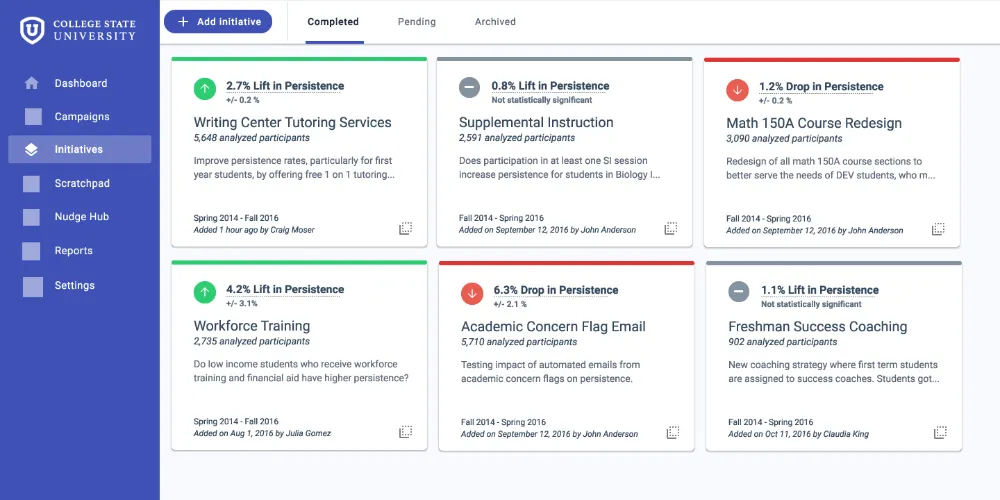
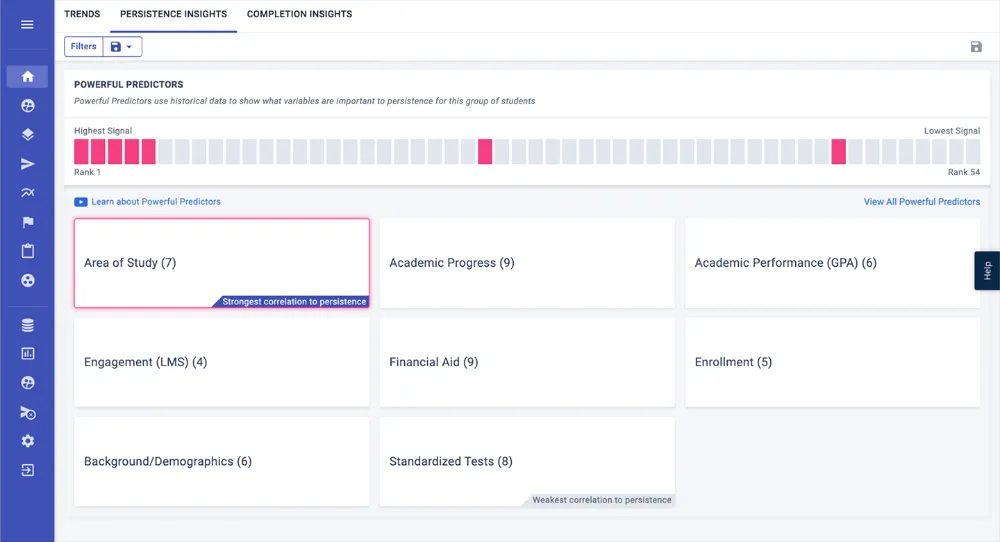
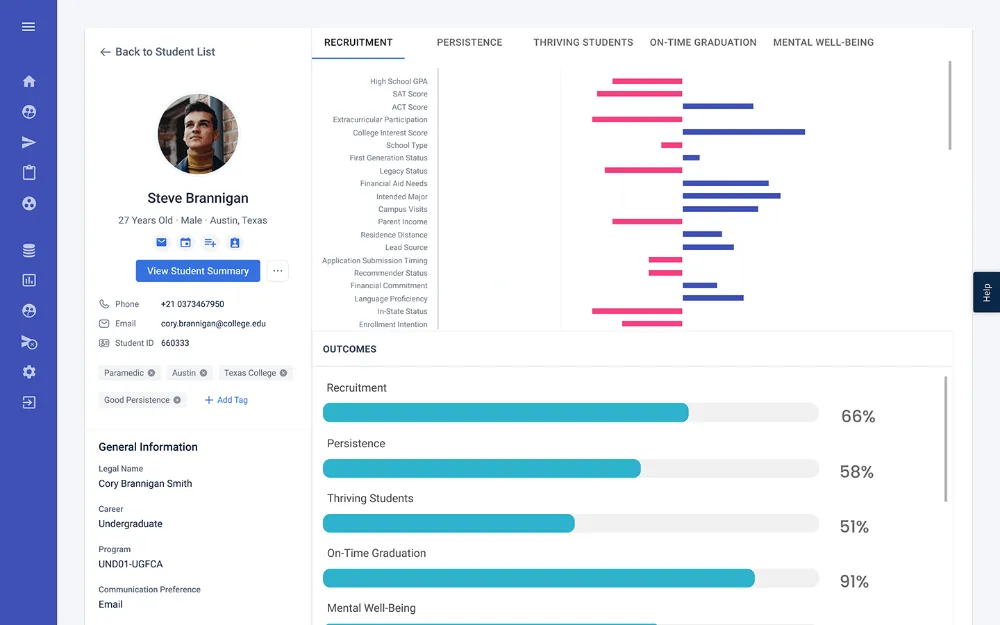
Predictive factors and initiative impact by program

See what drives every outcome, and what moved it.

  • Six outcomes, each with an institution-specific model
  • The factors behind each prediction, by student population
  • Initiative impact against a matched comparison group
Actionable analytics →
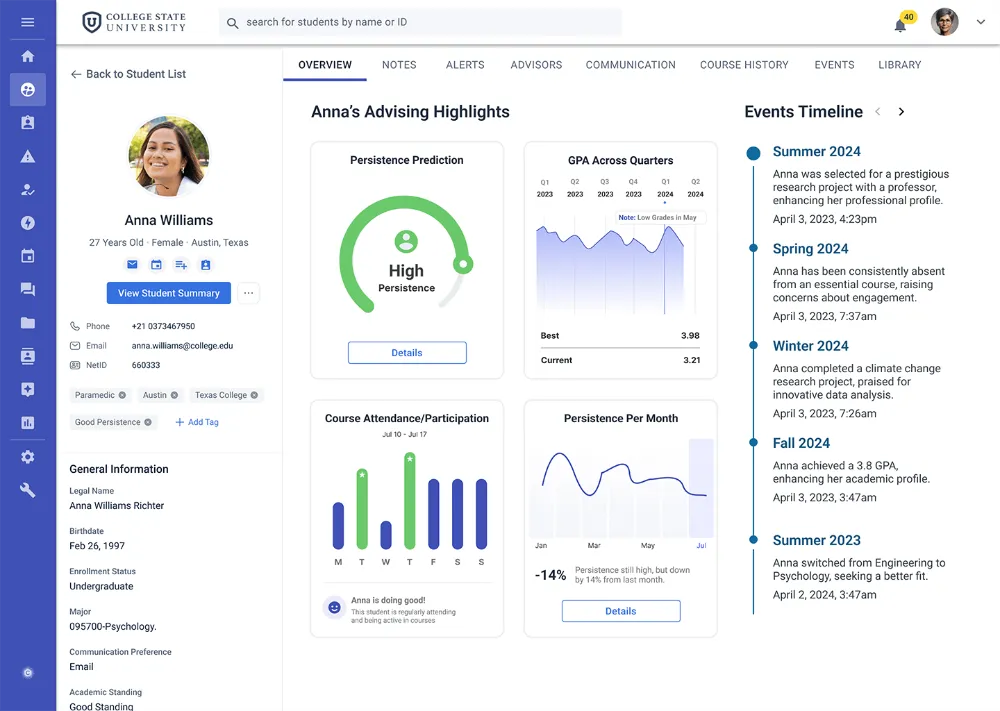
One student record shared across offices

One student record, shared across every office.

  • A ranked daily list with the reason attached
  • Shared notes, alerts, and case management in one place
  • Email and SMS outreach from the student record
Advising & student success →
Student schedule builder: find the best fit schedule

Plan the degree, build the schedule, register.

  • Degree plans built with an advisor
  • Schedules that fit the hours a student can attend
  • Courses, alerts, and messages in a native mobile app
Inspire, the native student app →
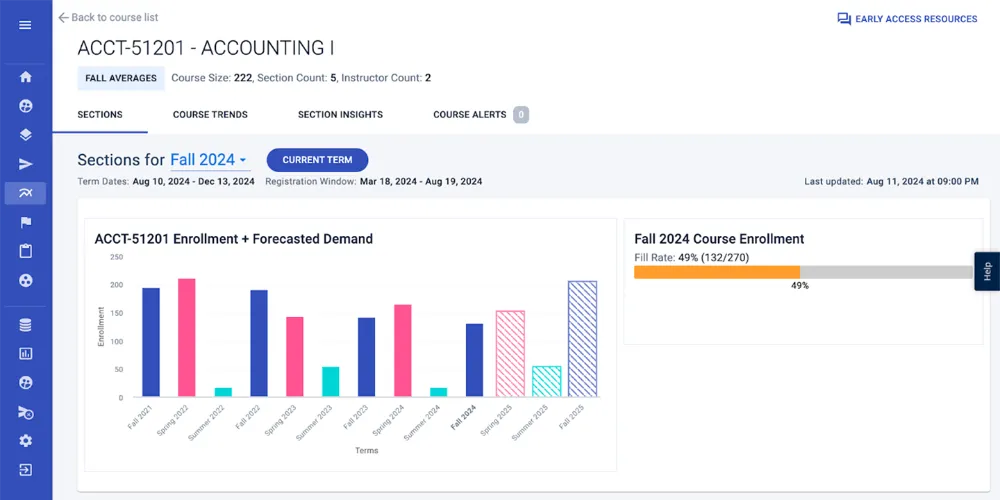
Real-time section fill and course demand forecast

Open the seats students need, before they need them.

  • Real-time section fill by course
  • Course demand forecast from degree plans
  • The course that is blocking the degree, by section
Academic leaders & faculty →
Post-Graduation Outcomes: employment within 6 and 12 months, time to first job, current salary, and salary growth by graduation year

Graduate jobs and salaries, program by program.

  • Employment at 6 and 12 months, and time to first job
  • First and current salary, and salary growth
  • Four years out and beyond, by graduation year
Career outcomes →
The questions your cabinet will ask

How do you know if a student success intervention actually worked?

Any tool can send a message. Few can tell you if it changed anything. With performance-based funding, tight budgets, and AI on every vendor slide, ask three questions before you sign.

Question 1

Are the predictions built on our students?

National-average models miss the patterns at your institution: the 14-credit part-timer, the transfer with a math gap. Civitas trains a model per institution on your SIS, LMS, and CRM history.

Question 2

Which interventions are really working?

Only 40–60% of student success initiatives produce a measurable outcome. Civitas measures each one against a matched comparison group. Fund what works; retire what doesn't.

Question 3

Do we know what AI does on our behalf?

Every agent action is logged, attributed, and reviewable. Your staff set the guardrails, and the audit trail is yours.

The lead use case · student success

What can AI agents actually do for a college?

They do the work, and a ledger proves it paid off. Civitas has built AI for colleges since 2011, through several generations of the technology, and student success is where partners proved it. Each agent acts on your own predictions, inside your teams' systems, and reports its impact to the same ledger.

Recruit & enroll

Fill the class with students who will finish.

Every admit gets two scores in your counselors' CRM: will they enroll, and will they be here in year two. Counselors work the top of the list; the agent works the rest.

  • agentYield agent — the day an admit goes quiet, drafts outreach, books follow-up, and logs it in the CRM.
  • agentRegistration agent — finds continuing students unregistered by week two, names the hold, and clears it with them.

3.7% registration increase, Fall 2022 to Spring 2024, SUNY Broome · Strategic enrollment →

Success & progress

Keep the students you already have.

Retention is the cheapest enrollment you will ever buy. Your own model scores every student weekly, so advisors see the week-four slide before it becomes a week-twelve withdrawal.

  • agentAdvising agent — builds each advisor's daily list, drafts the note, and books the meeting before a second missed class.
  • agentCare coordination agent — turns an advising alert, an aid hold, and a tutoring referral into one case with one owner and one plan.

12% retention increase, Fall 2022 to Fall 2023, Snow College · Advising →

Graduate & employ

Move students to the finish line, and past it.

Students stall thirty credits from a degree on one course. The completion agent finds them by name, the term before.

  • agentCompletion agent — flags the senior blocked by one section, then fixes the plan or finds the seat.
  • agentOutcomes agent — tracks graduate employment and reports it to programs and IR, so program review starts with a number.

13% increase in two-year completion, Fall 2015 to Fall 2021 cohorts, Austin Community College · Completion → · Career outcomes →

Beyond the student journey

Every office gets a scoreboard, not just an agent. The same data, models, and ledger answer the cabinet's other questions.

Course demand & schedulingPredict section fill by term. Open the sections students need; close the rest.
Program portfolioEnrollment, completion, and cost per program in one view.
Financial aid leverageFind where one more aid dollar changes a yield or persistence decision, and where it doesn't.
Institutional researchOne governed dataset for IPEDS, accreditation, and board reporting, with the intervention record attached.
Program accountabilityGraduate earnings by program against the federal earnings test, years before the determination. Career outcomes →
Student engagementCourse-level engagement and section fill by week, for deans, chairs, and faculty. Engagement →
Career outcomes · Program accountability

What do your graduates earn four years after they finish?

The federal earnings test will ask. You should know first. The Department of Education runs the official test on its own wage records. Civitas gives you the same view early, on your own graduates, so you can act while a program can still change. The career module matches every graduate to employment data and follows each cohort year over year, so deans see jobs and salaries by program long before the Department's determination arrives.

  • Employment at 6 and 12 months, time to first job, and major alignment
  • First salary, current salary, and salary growth, by program and graduation year
  • Every job, promotion, and employer, and where graduates work
  • Career readiness while students are enrolled, so there is still time to act

Nearly $13,000 more than the local average in post-graduation earnings for UT San Antonio graduates, and second-year retention up as much as 33% — both as reported by UTSA, which credits its Hub-and-Spoke framework. How UTSA did it →

Outcomes by major: graduates, employment at 6 and 12 months, major alignment, stayed local, months to job, current salary, and salary growth for every program
Free · the Civitas National Career Survey

Most institutions have no fourth-year-out earnings data at all. We published the national picture.

Employment timing, the earnings premium four years out, geographic mobility, and career paths, pooled across 11 institutions and published as privacy-protected aggregates under a neutral identity — not any one school's numbers. Filter 2-year against 4-year, public against private, and see which programs the earnings rule is projected to catch.

Why the data matters

What is the difference between a generic AI agent and an institution-specific model?

Generic AI knows higher ed. Civitas knows your students. An agent is only as good as the prediction behind it. Compare the platforms →

Generic AI agent sector model

  • Predictions from national benchmarks or one vendor's pooled customer base.
  • Outcomes modeled are usually one: will this student come back.
  • Risk flags from rules: a slipping GPA, a missed registration, an unopened email.
  • Proof is activity: open rates, reply rates, hours saved, "exceeded expectations".
  • Scope is the front door: marketing, admissions, inquiry response.

Civitas Learning your model

  • Predictions from a model trained on your SIS, LMS, and CRM history — refreshed each term.
  • Outcomes modeled are six, each its own model: persistence, graduation, engagement, thriving, grades, and career outcomes.
  • Risk flags from a model trained on your history: grades, credits, course patterns, aid status, and engagement together.
  • Proof is outcome: persistence, completion, and revenue lift vs. a matched comparison group.
  • Scope is the whole institution: enroll, persist, graduate, employ, and the courses, programs, and budgets behind them.
The AI vendor checklist

Ten questions to ask any AI vendor. Including us.

Get the full checklist →
  1. What is your model trained on: our students, or the sector?Listen for "your history, retrained every term."
  2. How do you find a student at risk: rules, or a model?Ask for the list of signals. A short, obvious list is rules.
  3. Show me a lift number against a comparison group.Listen for the number, the group size, and the confidence interval.
  4. Name an intervention of yours that did not work.A vendor that has never found one is not measuring.
  5. What does one point of retention pay back at an institution our size?Headcount, net price, one point, a dollar figure.
  6. Which of our systems do you replace, and which do you read from?"Operating system" and "ontology" are replacement language.
  7. How long until an advisor sees a prediction on a real student?Ask for an institution that hit that date.
  8. How often is the model refreshed?Once at install is a model of an institution that no longer exists.
  9. How many institutions, how many published outcomes, and can we call three?A count, a link, and three names.
  10. What is your status under FERPA, and where is the data sharing agreement?The document, not a badge.
Impact spotlight

What partners built, and what it moved

“We’ve always known that holistic advising is the right approach, but the Civitas Learning platform allows us to actually do that.”
Leslie Abarr-CuencaDirector of Student Success, Northwest Missouri State University
+8%
retention increase, 2016 to 2021, reaching 80% overall retention from Fall 2021 to Fall 2022
What they built
  • One student profile, curated with the campus: alerts, appointment notes, relative LMS engagement, changes in persistence prediction, and texts
  • Advising, the registrar, financial aid, athletics, and support units documenting interactions and managing alerts in one system
  • A daily review of each student’s LMS engagement relative to peers, to see who needs support sooner
  • A campuswide model for “every student, every day” that every office signs up to
“When everybody told us six years ago, you’re never going to be able to move a needle from 81 to 82% at a state school, this fall we are at 86.4%.”
Dr. John RindyAssistant Vice President for Career and Academic Progress, Slippery Rock University
86.4%
first-year retention, the highest on record (preliminary, pending PASSHE verification). SRU also credits career readiness, advising, and mentoring.
What they built
  • Institution-specific analytics with paired predictor analysis to find precise student groups
  • A program for exploratory students: 78–81% now declare a major in their first semester, up from 68%
  • Removing small financial barriers that stand between students and their next term
  • Data use built into daily workflows, with a partnership that adapts as the numbers move
“The Civitas Learning Student Impact Platform allows us to view student success through a data-focused lens. It ensures we’re not leaving any gaps that students could fall through along the way.”
Dr. Tammy WyattVice Provost for Student Success, The University of Texas at San Antonio
+16 pts
first-year retention, 2012 to 2022, as reported by UTSA; an 8.1% persistence lift for students who engaged with academic advising, Summer 2020 to Fall 2021
What they built
  • Advising caseloads built from the paths students actually take when they change majors
  • Tutoring and supplemental instruction measured by student group, then focused where they worked best
  • Targeted coaching outreach to at-risk students who would not seek it out on their own
  • Weekly leadership reviews of student success data across a hub-and-spoke structure
Strategic partnership
“The service during integration is beyond expected. I've never felt we're just a number.”
Erin GunnellDirector of Success Advising & Tutoring, Ensign College
Frequently asked questions

What institutions ask before they buy

Short answers, in the words a cabinet uses. For anything not here, ask us directly.

How do we know if our student success interventions are working?

Measure each initiative against a matched comparison group of students who did not receive it. Civitas builds that group from your own records, so you see the lift the initiative produced, not this year versus last. Across more than 220 measured initiatives, only 40 to 60 percent produced a measurable outcome. How efficacy is measured →

What is one point of retention worth to our institution?

Undergraduate headcount times one percent, times net price per student. At 9,000 students and $11,500 net price, that is 90 students and just over $1 million a year. The calculator on this page uses your own IPEDS figures.

What does Civitas Learning actually do?

Civitas connects the systems a college already runs into one model of the institution, trains predictive models on its own history, gives staff and students tools to act, and measures what each action changed. The tools include an advising CRM with case management, degree planning, registration, class scheduling, and a native student mobile app, so Civitas can be your advising system of record or work beside the one you have.

Do we have to replace our SIS, LMS, or CRM?

No. Civitas reads from more than 100 systems, including Banner, PeopleSoft, Colleague, Workday Student, Canvas, Blackboard, Slate, and Salesforce, and writes actions and results back. It never replaces the SIS or LMS. For advising, Civitas ships its own CRM: consolidate onto it or keep yours. How that compares →

Is Civitas just analytics, or can our advisors and students work in it?

Both. Advisors get a CRM with case management, shared notes, academic alerts, dynamic lists, and email and SMS outreach. Students get degree planning, the schedule builder, registration, appointment scheduling, and a native student mobile app. Analytics and comparison-group measurement sit under all of it. What an advising team gets →

How is this different from a generic AI agent?

A generic agent predicts from national benchmarks or a vendor's pooled customer base; Civitas trains a separate model on each institution's history and refreshes it each term. The proof differs too: agent vendors report activity like open rates and hours saved; Civitas reports persistence, completion, and revenue against a comparison group. Ten questions to ask any AI vendor →

How long has Civitas Learning been building AI for higher education?

Since 2011 — fifteen years, through several generations of AI, from institution-specific predictive models to AI in advising and planning workflows to today’s agents. Every generation learned from the institution’s own data and was judged on measured outcomes. Civitas Learning AI →

What do you predict, and what is each model built on?

Six outcomes, each with its own institution-specific model: persistence, graduation, engagement, thriving, grades, and career outcomes. Each model is trained on your SIS, LMS, CRM, and aid history instead of sector averages, and retrained each term. How the models work →

Can we see what our graduates earn, by program?

Yes. The career module matches every graduate to employment data and follows each cohort for years: jobs, first and current salary, salary growth, and where they work, by program. Deans see each program against the federal earnings test, which reads earnings four years after graduates finish, years before the determination arrives.

How long does implementation take?

Lawrence Technological University went live in six weeks. Timelines depend on how many systems are in scope and how clean the data is, so ask any vendor, including us, to name an institution that hit the date they quote. Read the deployment story →

What does Civitas Learning cost?

An annual platform subscription scaled to institution size, with no per-agent charge and no token metering. Scope, the number of integrated systems, and the level of partnership set the price. How pricing works →

Is our student data used to train models for other institutions?

No. Every model is trained on your institution's own data, and your data is never pooled into a benchmark sold to another school. Civitas operates as a school official under FERPA, under a data sharing agreement you sign. Security and privacy →
Next step

Bring your questions. Leave with an estimate you can defend.

A 45-minute working session: we start from your public IPEDS figures, show what the platform found at institutions like yours, and size the outcome — before anyone touches your data.