Get in Touch
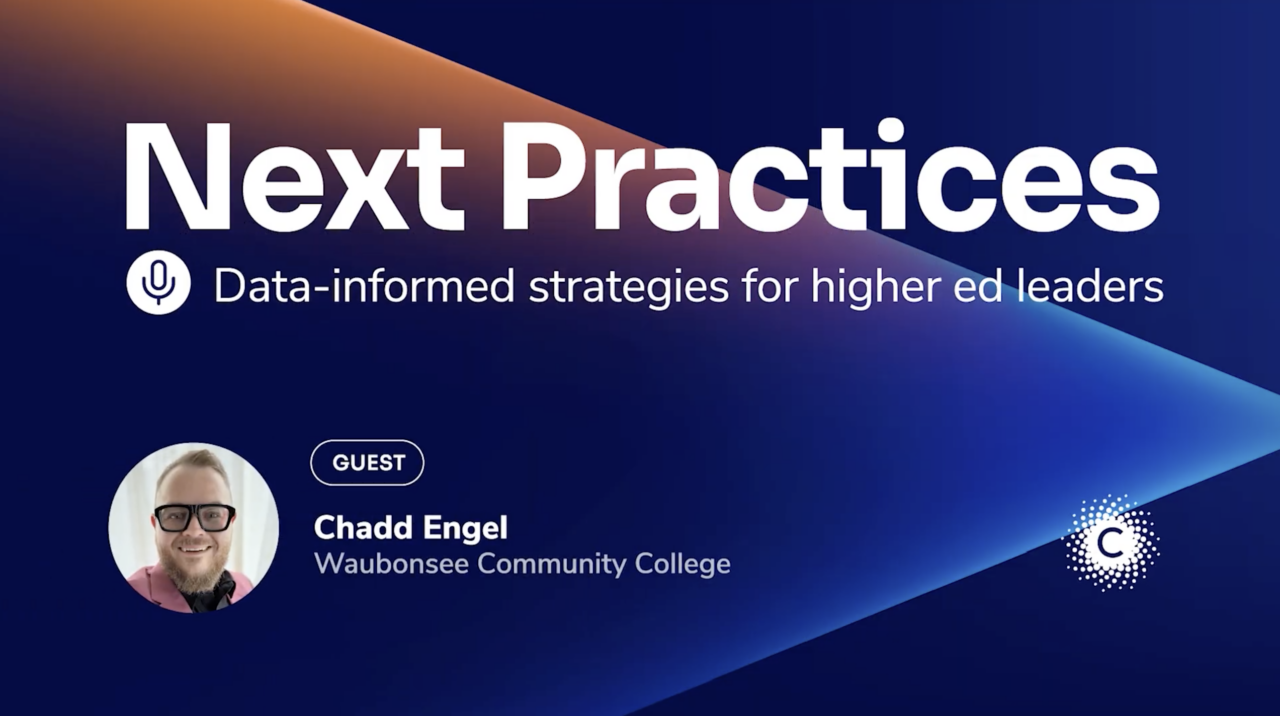
Using AI to Strengthen Student Relationships
Share this Post
Subscribe: Spotify | Apple Podcasts | Youtube Music | Transcript
There’s a simple question Chadd Engel uses to evaluate every AI use case: does it lead to more human-to-human interaction?
If the answer is no, he says, you need to scrutinize why you’re doing it.
In this episode of Next Practices, Chadd — an AI and learning systems leader at Waubonsee Community College and PhD candidate at DePaul University, where he’s defending his dissertation on AI in community college instruction — makes a case for using AI not to automate relationships, but to deepen them.
His argument isn’t about the technology. It’s about what advisors, coaches, and student success practitioners do with the time and context AI can give back to them.
🤔 What You’ll Learn in This Episode
How should higher ed leaders filter out AI hype and focus on what actually matters? Use human connection as your filter. If a use case leads to more human-to-human interaction, it’s worth pursuing. If it reduces human interaction, scrutinize it hard — not as a hard stop, but as a serious check on your reasoning before moving forward.
How can AI help advisors build stronger student relationships? By surfacing the personal context advisors already collected but can’t always hold at scale. When an advisor walks into a follow-up knowing a student’s story — not just their GPA — that conversation lands differently. AI doesn’t create the relationship. It helps you show up to it prepared.
What’s the right first goal for AI adoption — efficiency or quality? Focus on raising the floor of your work before you try to reduce time on task. When you eventually do create capacity, the question becomes: what human connection are you filling that time with?
What should leaders look for in an AI tool to know it’s actually human-centered? Look for tools built around dialogue, not solution delivery. They should remain open and curious, not push you toward predetermined answers. And evaluate them the same way: in person, as a group, with curiosity leading the conversation.
How do you build AI literacy across a campus without waiting for a committee? Start a grassroots movement. When you learn something, share it with two people. Ask them to do the same. Model the dialogue you want your institution to have — and keep going, because the technology is moving faster than any committee can govern it.
The Filter that Changes Everything
Most conversations about AI in higher education start with the technology — what it can do, what it can’t, whether it’s safe to use. Chadd Engel starts somewhere else: with the relationship.
His core value proposition, which he’s developed for both his own practice and his institution, is straightforward: if your AI use case leads to more human-to-human interaction, it’s worth pursuing. If it reduces human-to-human interaction, scrutinize it. That single frame, he argues, cuts through more noise than any vendor evaluation rubric.
It also reframes what “success” looks like for AI implementation in student success work. The goal isn’t to automate advising. It’s to provide advisors the context and capacity to be more present — more human — in every conversation they do have.
What AI Actually Provides Advisors
Advisors in higher education carry something that’s easy to underestimate: hundreds of small, personal details about students. Someone mentioned they’re from a single-parent household. Someone else is a cat person, not a dog person. These details matter. They’re the connective tissue of trust.
But when you’re managing a caseload of 100 or more students, those details get hard to hold. Chadd describes a world where AI helps surface that context at the right moment — so when an advisor follows up with a student who’s fallen behind, they can open with something personal, not transactional. “I would argue,” he says, “that there’s an opportunity if we remember and are able to pull on those personal touchpoints.”
This is the difference between a student feeling like a case number and feeling like someone at the institution actually knows them.
The same logic applies at the institutional level. Chadd points to a practical example: advisors can build a custom AI tool trained on publicly available program and pathway information, so when a student walks in as an architectural engineering major and leaves the conversation interested in digital marketing, the advisor can navigate that transition in real time. “It’s not fair to expect any human — even the curriculum manager — to be able to transition from program to program and remember every prereq and co-req on the spot.” A tool that carries that load frees the advisor to carry the relationship.
Raise the Floor Before You Reduce the Time
One of Chadd’s sharpest points in this conversation is about the order of operations for AI adoption. Many institutions lead with efficiency — AI will save you time. Chadd pushes back.
“Your first focus should be to raise the floor and quality of your work.” Time savings may come eventually, he argues, but chasing them first is the wrong frame. If you focus on quality, you’ll start finding real value. And when time reduction does follow, the question you should be asking is: what human connection am I filling that space with?
This reframe matters especially for student-facing roles. An advisor who uses AI to feel more prepared, more confident, and more present isn’t just doing their job more efficiently — they’re doing it better. That difference shows up in whether students stay.
Dialogue over Solution-Thinking
Chadd’s framework for evaluating and implementing AI tools centers on a concept he calls the “dialogue model” — fundamentally different, he says, from the Western speaker model where the goal is to win or dominate a conversation.
In a dialogue model, you stay curious. You ask open questions. You’re not pushing toward a predetermined solution. You listen to where the conversation leads, and you let that path surface creative and innovative use cases that solution-oriented thinking would have closed off before they emerged.
He applies this both to how institutions should discuss AI adoption internally and to how AI tools themselves should be designed and deployed. “The more you can model that in front of your employees, staff and faculty, and your students, the better off you’ll be in the long run.”
It’s also his answer to the fear and fragmentation that characterizes a lot of AI conversations on campus right now. People are afraid of being surveilled, of being replaced, of trusting outputs they can’t verify. Those concerns are legitimate, Chad says — and they show up at every technology transition. The antidote is more dialogue. Get in a room, record the conversation, pull out what matters, and iterate together.
Reframe the AI Moment in Higher Education
Chadd doesn’t soften this: most institutions are two to three years behind where the technology already is. Committees are still debating governance frameworks for tools that have already moved on.
His advice isn’t to panic. It’s to engage. Stop waiting for perfect conditions and start building the grassroots capability your institution actually has. Share what you learn with two people and ask them to do the same. Start conversations with curiosity, not committees. And keep your eye on the horizon — because what’s coming, including real-time language translation that lets students communicate in their first language regardless of what their advisor speaks, is going to change the shape of student success work in ways most campuses haven’t started preparing for.
Better Systems Start with Stronger Relationships
Chadd closes with an idea worth sitting with: “The future of AI within this upskilling, higher education conversation isn’t necessarily about smarter systems. It’s about building stronger human relationships.”
If that’s the north star, the practical work becomes clearer. Evaluate tools against it. Design adoption conversations around it. Measure success by it.
If your institution is trying to figure out where to start — or trying to move past the committee stage and into actual practice — this episode is worth your time.
Links & Resources:
- Chadd Engel Bio Page
- Chadd Engel (LinkedIn)
- Waubonsee Connection Spans Generations in the Engel Family

Chadd Engel
Chadd Engel is an AI and learning systems leader whose work bridges generative AI, pedagogy, data infrastructure, and institutional transformation across K–12, higher education, and community-based settings. A Ph.D. candidate in Curriculum Studies at DePaul University, his research focuses on transparency, ethics, and safeguarding human agency as AI becomes embedded in learning and decision-making systems. Guided by the belief that transparency is a prerequisite during times of disruption, he is committed to building AI and data environments that amplify human judgment and remain accountable to the communities they serve.