Get in Touch

Student Success Doesn’t Live in One Department
Share this Post
Subscribe: Spotify | Apple Podcasts | Youtube Music | Transcript
When Academic Affairs and Student Affairs operate separately, students feel the gap — in disconnected advising conversations, in handoffs that go nowhere, in support systems that don’t reach them in time.
At Bergen Community College, two vice presidents decided to close that gap.
In this episode of Next Practices, Dr. Andrew S. Tomko, Vice President of Academic Affairs and Provost, and Dr. Anthony (A.J.) Trump, Vice President of Student Affairs, shares how they moved from cordial co-existence to genuine collaboration — and why institutional data became the bridge that made it possible.
Their conversation covers the “pivot point” that forced them to align, how they structure weekly working sessions around hot-button issues, and why they’ve made it a priority to look at Bergen’s own data rather than defaulting to national benchmarks.
🤔 What You’ll Learn in This Episode
What finally breaks down the wall between Academic and Student Affairs? Dr. Tomko and Dr. Trump share the specific moment that shifted their dynamic — and what it took to move from parallel work to a joint operating rhythm.
How do you make data useful for frontline staff without overwhelming them? Deliver insights in small, targeted pieces that connect directly to the work people are already doing. Too much data at once and people shut down. A well-timed insight actually gets used.
What does a working session actually look like? Every Monday, Bergen’s deans and student affairs leadership sit down together — not to report out, but to strategize. They work through the week’s hottest issues together, using data to diagnose, decide, and move.
Why does institutional data outperform national benchmarks? Because your institution isn’t the average of ten others. What Bergen sees in its own data reflects its own students, its own context, and its own opportunities for improvement — none of which a national survey can reliably surface.
How do you build a culture of shared accountability for student outcomes? Anchor it in a common language, a regular meeting rhythm, and a shared commitment to continuous improvement — not just shared access to a platform.
Why Academic and Student Affairs Struggle to Collaborate
In many institutions, Academic Affairs and Student Affairs co-exist without truly collaborating. They have different reporting lines, priorities, and definitions of what student success means. The result is that students move between systems — from a class to an advisor to a support office — and experience each as its own separate world.
Dr. Tomko and Dr. Trump came into their roles at Bergen with a different intention. Their starting point wasn’t technology or data strategy. It was a decision to work as genuine partners. The data tools came later and the relationship came first.
What accelerated their alignment was a shared challenge — a moment when the scale of the problem made staying in separate lanes impossible. That pivot point is something they discuss directly in the episode, and it shaped everything that followed.
How to Make Data Useful for Frontline Staff
One of the recurring themes in this conversation is the gap between having data and actually using it.
“You can’t overwhelm people with a whole lot of data,” A.J. says. “You want to give little snippets, here and there, that help move the initiatives that you’re working on forward. If you give everybody everything at once, it’s too much to keep track of.”
Rather than pushing every available metric to every staff member, A.J. and Andrew focus on surfacing the specific insight that’s relevant to the specific decision in front of a specific team at a specific moment. When data arrives that way, people use it.
The practical anchor for this is their Monday leadership meeting. Each week, Andrew’s deans and A.J.’s leadership team sit down together — not for a status update, but to work. They surface the hot issues from the week, look at what the data is showing, and decide together how to move forward. “What should we do to make continuous improvement in our processes?” A.J. describes it as a working session with a real purpose: turning information into action.
Why Institutional Data Beats National Benchmarks
There’s a temptation in higher education to reach for national benchmarks as a source of truth. They’re credible, they’re easy to reference, and they provide a kind of institutional cover. If a national report says most community colleges struggle with X, it’s easy to point to that when X shows up at your institution too.
A.J. pushes back on that instinct — directly.
“Data’s tough. People sometimes like to talk from national data. And I’m going to tell you — national data is great. But you really want to look at your own institution’s data, because how our institution is set up is very different than how maybe the ten institutions that were surveyed for that national data.”
The point isn’t that national benchmarks are useless. It’s that they can become a substitute for the harder work of looking at your own students, your own outcomes, and your own patterns. “What are our success outcomes?” That’s the question Bergen asks — and the answer almost always comes from Bergen’s data, not someone else’s.
How Bergen Runs Cross-Divisional Student Success Work
A few things stand out from how Dr. Tomko and Dr. Trump actually run this work:
- Start with the relationship, not the platform. Bergen’s data collaboration only works because the people involved trust each other. A.J. and Andrew built that trust through consistent, structured interaction — not by rolling out a tool and hoping adoption would follow.
- Make the Monday meeting non-negotiable. Weekly leadership sessions between Academic Affairs and Student Affairs are common in theory. Bergen’s version has teeth because it’s a working session, not a briefing. People come prepared to make decisions, not just share updates.
- Feed insights to the people who can act on them. Getting data into the hands of frontline staff — advisors, coaches, faculty — is a deliberate strategy, not an afterthought. The goal is to change what happens in the moment of a student interaction, not just what appears in a dashboard.
- Use your own institutional data as the primary source of truth. National benchmarks provide context. Your own numbers tell you what’s actually happening with your students and where the real opportunities are.
The One Thing That Survives a Leadership Transition
One of the questions posed in the conversation is this: if your successor inherits this system three years from now, what’s the one cultural shift you hope is most deeply rooted in Bergen’s identity?
That question applies to every institution, not just Bergen. Systems can be replaced. Platforms can be swapped out. But a campus where Academic Affairs and Student Affairs genuinely see themselves as partners — where they share accountability for student outcomes and make decisions together — is something different. That’s harder to build and harder to undo.
Dr. Tomko and Dr. Trump are explicit that Bergen isn’t finished. But they’ve built something real: a working model for what cross-divisional collaboration looks like when it’s anchored in shared data, a consistent operating rhythm, and a genuine commitment to the students in the middle of it.
Links & Resources:
- Bergen Community College
- Andrew Tomko, Ph.D. – Bergen Community College
- Dr. Anthony (A.J.) Trump – Bergen Community College
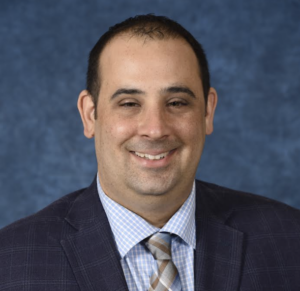
Dr. Anthony (A.J.) Trump
Dr. Anthony (A.J.) Trump is Vice President of Student Affairs at Bergen Community College, where he leads enrollment management, student services and success, advising, student life, athletics, and compliance initiatives across three campuses. A data-driven and collaborative executive, he advances strategic enrollment management, inclusive postsecondary education, and technology-enabled student success strategies that improve retention and graduation outcomes. He is actively engaged in statewide higher education leadership and is committed to ensuring every student has the opportunity to grow, belong, and succeed.

Dr. Andrew S. Tomko
Dr. Andrew S. Tomko is Vice President of Academic Affairs and Provost at Bergen Community College, where he began in 1994 as a tenure-track faculty member in the English Department. He has also held the positions of Composition and Literature Coordinator, English Department Chair, and Dean of two academic divisions. He oversees the four academic divisions of the college, including full-time and adjunct faculty, the library, and tutoring center, and is actively involved in a number of New Jersey statewide initiatives in higher education.