
Many institutions believe they need flawless, standardized data before using analytics or predictive insights. In reality, waiting for “perfect data” only slows momentum and delays results. You don’t need perfect, uniformly formatted data—you need the data you already have to be usable and connected**.**
The right information already exists across your student systems—academic records in the SIS, engagement data in the LMS, communication histories in the CRM, and countless other sources. The challenge isn’t the volume of data; it’s that these sources were never designed to work together. When information is fragmented and unstandardized, teams can’t see the full student picture or take timely, informed action. Connecting these sources into one cohesive view allows institutions to replace assumptions with insight that drives action.
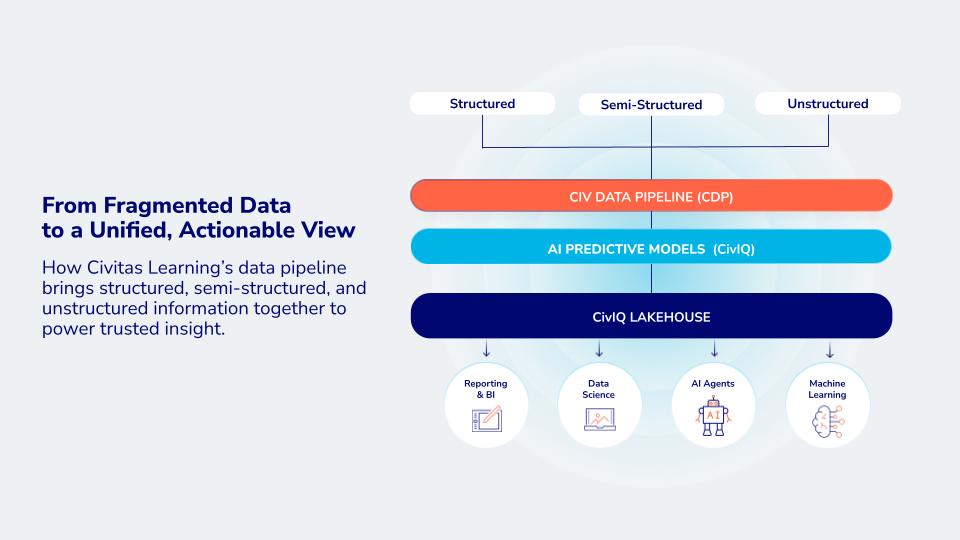
Civitas Learning’s unified data pipeline connects and standardizes structured, semi-structured, and unstructured information to create a single, trusted foundation for analytics and action.
But disconnected systems aren’t the only obstacle. Even when data is accessible, it’s often captured in different formats, structures, and standards across departments—creating disorganized or unstandardized data that makes it difficult to act with confidence. Civitas Learning addresses both challenges through its unified data pipeline and built-in data standardization—ensuring institutions get connected, trusted, and actionable intelligence without waiting for a massive cleanup effort.
At a recent Civitas Learning Leadership Workshop in Chicago, partner institutions shared how they began centralizing and streamlining their student success data. Both SUNY Broome and Michigan Tech described the same starting point—fragmented systems, reactive outreach, and manual processes that stretched staff thin. Their success proved that meaningful transformation doesn’t require perfect data—only the commitment to begin.
The Challenge: Manual and Disconnected Systems
Before partnering with Civitas Learning, SUNY Broome’s advising model was decentralized and inconsistent. Each department managed student records differently—some in spreadsheets, others in email chains or paper files. This fragmented approach made it nearly impossible to see a full picture of student progress.
- Siloed Communication: Advising practices varied across divisions, and decentralized data meant faculty and staff couldn’t see prior outreach or interventions—forcing students to repeat their stories and creating frustration.
- Reactive Support: Without early-warning signals, outreach often came too late — after missed assignments, poor midterm grades, or excessive absences.
- Overextended Staff: Advisors managed up to 250 students each, relying on intuition rather than insight, and spending hours reconciling records instead of supporting students.
It was important to make student information easier to access and help teams communicate and collaborate more smoothly—especially for faculty and staff who often struggled to share student details.
At Michigan Tech, the challenge went beyond technology—it was about culture and change management. After years of relying on homegrown, faculty- and staff-built reporting systems—high-expertise solutions that served the institution well but weren’t designed to scale—many team members were understandably skeptical about whether an outside platform could replicate or improve on what they had created. When the university partnered with Civitas Learning in 2020, progress was further complicated by significant staff turnover during the pandemic.
By 2023–2024, new leadership began a comprehensive review of processes and technology, unsure whether the platform could effectively support the Academic Intervention Team (AIT)—a group of primarily student affairs professionals responsible for tracking student progress tied to grants and identifying at-risk students.
Progress started with a small group of early adopters who tested Civitas Learning’s tools, demonstrated tangible results, and built credibility across campus. Their strategy was deliberate and transparent: start small, prove value, and scale success.
Why This Matters: Clean, Connected, Actionable Data
Civitas Learning’s unified data pipeline doesn’t just combine SIS, LMS, and CRM data—it cleans, standardizes, and unifies every source, including semi-structured and unstructured information. That means institutions get a single, trusted, queryable source of truth without needing a major data engineering effort. It’s a foundation designed to help campuses start small, prove value quickly, and scale success over time.
And because the platform pulls in all institutional data—not just SIS, LMS, and CRM information—campuses gain a holistic, institution-specific foundation for analytics, outreach, and decision-making.
The Turning Point: Making Data Work for You
Once Civitas Learning’s Student Impact Platform was introduced, SUNY Broome centralized its advising workflows and replaced manual spreadsheets with real-time insights. Staff gained a clear view of student progress and risk indicators, allowing them to proactively reach out to students with low course engagement or recent withdrawals. This shared visibility eliminated duplicate outreach, improved collaboration, and ensured every student received timely, coordinated support.
In this year’s workshop, SUNY Broome shared a significant milestone: since Fall 2022, registration rates have increased by 3.2 percentage points, and first-time college students have seen an 8.3-point increase in retention over four years (fall-to-spring).
At Michigan Tech, the early adopters became advocates. After seeing measurable impact, such as improved persistence for at-risk students, the university expanded Civitas Learning across departments. The platform connected advising, academic support, and student success initiatives into one strategy, giving leaders the ability to identify which efforts truly moved the needle.
Conclusion: A Roadmap for Getting Started
You don’t need a full data overhaul to build a connected student success strategy; you just need to start small. Transformation happens incrementally, not all at once. Here are three takeaways for getting started:
- Identify one key challenge: Start with a measurable issue like persistence declines, registration delays, or inconsistent advising follow-up. Focus creates momentum, helping teams adjust processes, share information, and build confidence through quick wins.
- Bring together all relevant institutional data ( SIS, LMS, and CRM), as well as additional sources like unstructured data in the form of CSV files, notes, or survey results,into one connected view. Moving from anecdotes to evidence gives teams the clarity and confidence to act with precision.
- Act, measure, and expand: Take action on insights, track impact, and scale what works. Over time, expand integrations and refine models to deepen insight and improve precision.
SUNY Broome and Michigan Tech didn’t wait for perfect data or a full system overhaul. By connecting existing systems—no matter their state—through the Civitas Learning Student Impact Platform, institutions can transform everyday information into trusted insight that drives measurable ROI and build progress one success at a time.
Contact us to learn how our unified data pipeline can support your student success strategy. Or hear how DeVry University is already doing this in practice in our conversation with CIO Chris Campbell.
5 Questions to Ask Before Buying an AI Agent for Higher Ed
Before buying an AI agent, ask what information it acts on, not just what it can do. Five questions to put to any vendor, including us.
Read →blog postInaction Has a Price: The Hidden Cost of Delayed Student Success Investments
Every semester of delay has a cost. Learn how waiting on student success technology impacts students, advisor capacity, and institutional revenue.
Read →blog postBeyond Student Success: Evaluating Higher Ed Software, Vendors, & Institutional Fit
Features are easy to evaluate. Coordination is harder — and far more important to long-term institutional outcomes.
Read →Bring your questions. Leave with an estimate you can defend.
A 45-minute working session: we start from your public IPEDS figures, show what the platform found at institutions like yours, and size the outcome — before anyone touches your data.