Get in Touch

Beyond Student Success: Evaluating Higher Ed Software, Vendors, & Institutional Fit
Share this Post
At some point, every institution asks the same question: Are our investments actually working?
It’s the right question. But it usually leads to the wrong process — feature comparisons, vendor demos, and RFP checklists organized around capabilities instead of outcomes. The perspective narrows. Institutions end up evaluating what a platform can show in a 60-minute demo instead of whether it can drive coordinated action after go-live.
The question that unlocks a better evaluation isn’t “What can it do?” It’s: Do we have the system in place to turn platform insight into institutional impact?
That reframe changes what gets evaluated. Coordination is harder to evaluate than features — but it’s what actually determines whether the investment delivers. Whether insight travels across teams. Whether staff know where to act first. Whether improvement compounds term over term or resets each cycle.
As the Student Success Playbook puts it: “Projects create activity. Systems create outcomes.”
Most evaluations never get there.
Why the Best-Intentioned Evaluations Still Miss the Mark
The patterns that derail platform investments aren’t hard to spot in hindsight. They’re just easy to miss when the demo is impressive.
Alerts without prioritization. When everything is flagged the same way, staff interpret urgency on their own. Activity increases. Outcomes don’t. Burnout rises — because volume scaled without improving judgment.
AI without adoption. Predictive models only work when staff trust them enough to act. When predictions live outside existing workflows or feel opaque, teams hesitate. Over time, AI becomes something the institution has — not something teams use.
Predictions without context. Identifying risk isn’t the same as knowing where to act first. Without prioritization, more signals create more noise — not better decisions.
Implementation without partnership. Student populations shift. Models drift. Without a partner who stays engaged through those changes, even strong platforms gradually lose their value. Most vendors treat post-implementation support as optional. The institutions that see lasting impact treat it as essential.
Feature-led buying. The most capable tool and the most useful system aren’t always the same thing. Selecting for features without a plan for coordination increases complexity without improving outcomes.
What Separates a Point Solution From an Institutional Success Platform
A strong institutional success system isn’t defined by what it can show — it’s defined by what it enables.
It connects context across teams and data sources so advisors, faculty, and student support staff work from shared understanding. It surfaces institution-specific patterns earlier, rather than generic risk scores calibrated to national benchmarks. It helps teams prioritize where their attention makes the most difference. It reduces noise so staff know what’s actually driving risk — and why. And it learns from outcomes so strategies improve over time instead of resetting each term.
None of those are features. They’re capabilities. And they’re what separates a coordinated system from a well-marketed tool.
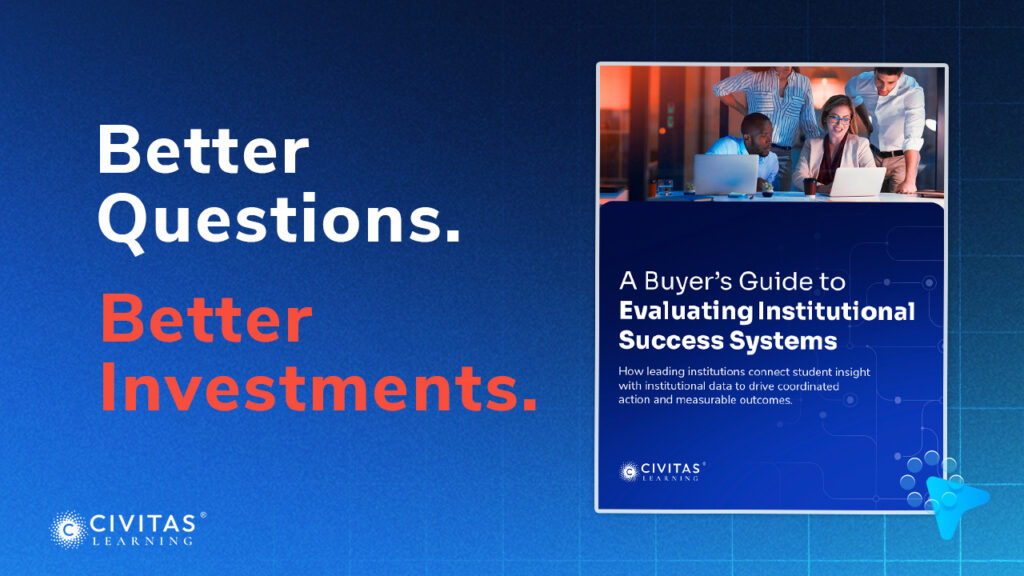
The Buyer’s Guide to Evaluating Institutional Success Systems walks through how to evaluate for exactly these capabilities — including a set of questions for AI specifically, where vague answers about model transparency, governance, and continuous improvement aren’t minor gaps. They’re deal-breakers.
The Best Vendors Don’t Disappear After Go-Live
Technology conversations focus almost entirely on the platform. What the vendor does after go-live rarely gets the same scrutiny.
It should.
Most implementations stall not because of the software, but because of data fatigue and staff resistance. The strongest partnerships don’t hand off at launch — they recalibrate models as student populations shift, help teams adopt new ways of working (not just new tools), and measure outcomes against institutional goals across terms.
That’s not a services add-on. It’s what determines whether the investment compounds or stalls.
Better Questions Lead to Better Investments
Feature comparisons are easy. Coordination is harder to evaluate — which is exactly why it matters more.
The right question isn’t which platform does the most. It’s which platform and partner will help your institution build a system that connects insight across teams, embeds action into workflows, and gets smarter every term.
Start with the system, not the software.
→ Read the Buyer’s Guide to Evaluating Institutional Success Systems